Oct 01, 2026
Read More >>
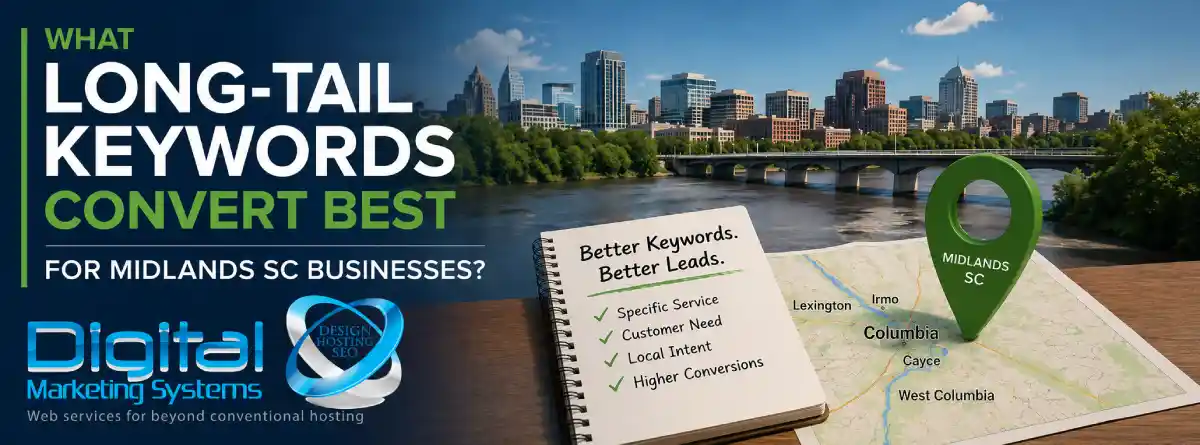
Quick Answer: The long-tail keywords that convert best for Midlands SC businesses usually combine a specific service, a very clear customer need, and a location. Phrases such as “emergency HVAC repair Lexington SC,” “commercial landscaping company Columbia SC,” or “family dentist accepting new patients Irmo SC” often attract fewer searches than broad terms, but they signal stronger intent and are closer to a decision.
Broad keywords can bring visibility, but they often mix together people with very different goals. A person searching “landscaping” may want ideas, photos, a job, or a company. Someone searching “weekly lawn maintenance for businesses in Columbia, SC” has identified the service, customer type, and area, making the phrase more useful for a focused local SEO strategy.
A converting keyword usually reveals what the searcher needs and how soon that need matters. Service phrases with words such as repair, installation, replacement, quote, near me, open now, accepting patients, commercial, or residential can signal stronger buying intent. The best phrase must still match a real service the business offers and a page that clearly answers the search.
A keyword does not need thousands of monthly searches to be valuable. For many Lexington and Columbia service companies, ten qualified visitors are more useful than hundreds seeking general information. Search volume matters, but relevance, competition, location, and the likelihood of a call or form submission often matter more.
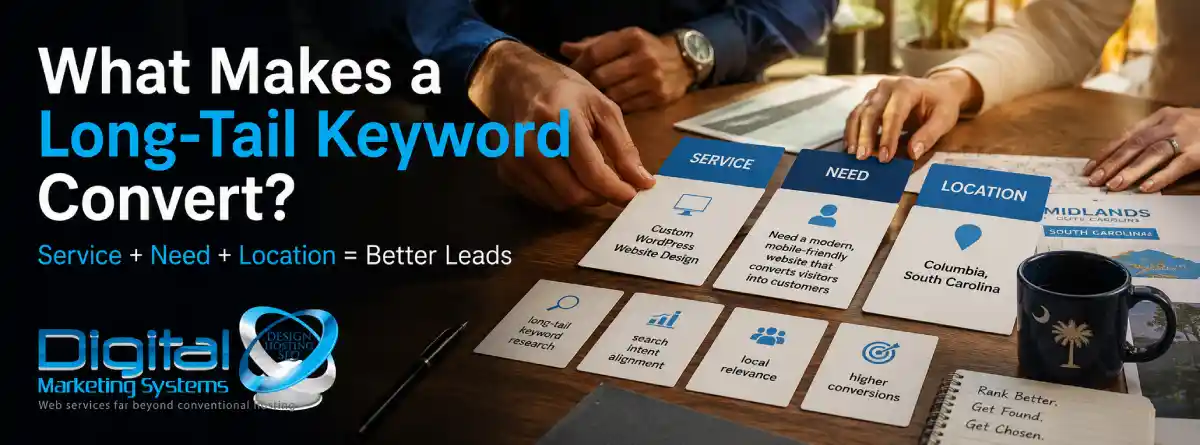
Strong long-tail phrases are often built from three parts: the service, the customer’s problem or goal, and the geographic area. Examples include “website redesign for law firms in Columbia, SC,” “pool leak repair near Lexington, SC,” and “ADA website review for small businesses in South Carolina.” Each phrase should lead to a page with useful details, proof, and an obvious next step rather than a generic page that mentions every service.

Long-tail keywords help a business compete where it is actually relevant. They can support service pages, location pages, FAQs, and blog topics that answer narrower questions. They also make it easier to write for people instead of repeating a broad keyword throughout the page. A well-planned phrase gives the page a clear purpose and helps search engines understand which search needs it addresses.
Common Mistakes
- Choosing phrases only because an SEO tool reports high search volume.
- Creating several pages targeting nearly identical keywords and competing with one another.
- Adding city names to weak content without including local service details or useful answers.
- Targeting a phrase that does not match the service, customer type, or page goal.
Best Practices
- Start with the questions customers ask before they call, request a quote, or schedule service.
- Build one strong page around each distinct service and search intent.
- Use the main phrase naturally in the title, headings, opening copy, metadata, and internal links.
- Review Search Console data and actual lead quality before expanding the keyword plan.
Midlands search behavior varies by service area. A company may need separate content for Lexington, Columbia, Irmo, Chapin, West Columbia, or nearby communities when the services, competition, or customer questions are meaningfully different. Separate pages should provide distinct local value, not the same paragraph with the city name changed. Supporting articles can also be developed through an ongoing SEO blog writing plan.
Professional help is useful when a business has many services, overlapping pages, declining traffic, or no clear way to connect keyword data with actual leads. An SEO review can identify search intent conflicts, missing service pages, weak metadata, internal-link opportunities, and technical issues. It can also help determine whether a new page, revised page, or supporting article is the right approach.
The best long-tail keywords are not simply the longest phrases. They are searches that closely match what the business sells, where it works, and what the customer is ready to do next. Digital Marketing Systems helps Midlands businesses build practical keyword plans around useful pages and realistic goals. To review your current opportunities, ask about SEO services for your website.
Frequently Asked Questions
What is a long-tail keyword?
A long-tail keyword is a specific search phrase that usually includes a service, problem, audience, feature, or location. It often shows more clearly what the searcher wants than a broad one- or two-word term.
Do long-tail keywords always have lower search volume?
They often do, but lower volume does not mean lower value. A specific phrase may attract fewer visitors but attract people more likely to call, request a quote, or schedule a service.
Should a business create a separate page for every long-tail keyword?
No. Closely related phrases with the same search intent can usually be covered on one strong page. Separate pages are more useful when the service, location, customer type, or requested solution is genuinely different.
How specific should location keywords be?
Use locations that match the company’s real service area and customer demand. Lexington, Columbia, Irmo, Chapin, and West Columbia may deserve separate attention when each page can provide distinct local information.
How long does long-tail SEO take to work?
Timing depends on competition, website history, page quality, technical health, backlinks, and search engine updates. Long-tail phrases may be easier to target than broad terms, but results are not immediate or guaranteed.